
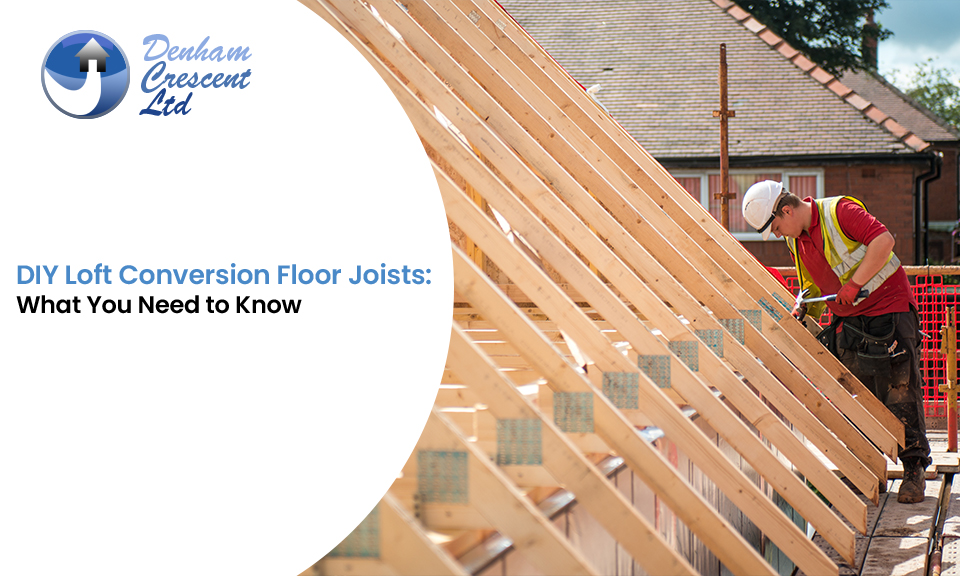
DIY Loft Conversion Floor Joists: What You Need to Know
11, May, 2026
Most lofts were built for storage, not for daily living. Existing ceiling joists are usually not strong enough to support a habitable loft conversion long term.
When planning DIY loft conversion floor joists, many homeowners assume the existing structure can handle the extra weight. In reality, a loft conversion adds significant structural load through flooring, insulation, partitions, furniture, and regular foot traffic. This is why most projects require new or strengthened floor joists.
At Denham Crescent, we regularly assess loft structures that appear usable initially but require major reinforcement before conversion work can begin.
Why Existing Loft Joists Are Not Enough
In many UK homes, the existing joists in the loft are ceiling joists, not structural floor joists. Their original job was simple. They supported the ceiling below, not a habitable room above.
Once a loft becomes a bedroom, office, or living space, the floor has to support:
Constant foot traffic
Furniture weight
Internal walls
Insulation and flooring systems
What Floor Joists Actually Do
Floor joists distribute weight safely across the structure of the house. Without proper support, the floor can begin to sag, bounce, or crack over time. A properly designed loft floor creates:
Stable weight distribution
Structural rigidity
Support for new rooms and walls
This is also where many DIY projects run into trouble. The joists are not simply timber pieces laid side by side. They work as part of a wider structural system connected to walls, beams, and load points.
Common Loft Floor Joist Sizes in the UK
The joist size depends on span distance, load requirements, and structural design.
Typical examples include:
These figures are only general examples. Two lofts with similar dimensions may still require different structural solutions depending on the property type and roof structure.
Can You Install Loft Floor Joists Yourself?
Technically, some parts of the loft floor preparation may be manageable for experienced DIY renovators. But structural floor installation is different from laying standard flooring boards.
The challenge is not simply fixing timber into place. The real issue is making sure the structure safely handles long-term load requirements. Most loft conversions also require:
Structural calculations
Building Regulations approval
Proper support points
Steel beam installation in many cases
Homeowners searching for DIY loft conversion floor joists focus mainly on timber sizes, but the bigger issue is whether the overall loft structure can support a habitable room long term.
When Steel Beams Become Necessary
Once larger spans or heavier loads are involved, timber joists alone are often not enough. Steel beams are commonly installed to:
Support new floor joists
Transfer loads safely to structural walls
Create open layouts below
Support staircase openings
Denham Crescent regularly works on loft conversions where steel support becomes essential once the new room layout and staircase position are finalised.
Building Regulations for Loft Floor Structures
Even if you plan to carry out some work yourself, Building Regulations still apply.
Inspectors will assess:
Joist sizing
Spacing between joists
Structural support
Fire safety
Insulation and sound resistance
In most loft conversions, joists are spaced around 400mm to 600mm apart, as designed. The floor must also support the required imposed load for habitable rooms under UK standards.
Read More: 3 meter house extension
The Mistakes That Cause Problems Later
A loft floor may feel stable initially, then start showing problems months later. Common mistakes include:
Using undersized joists
Relying on existing ceiling joists
Incorrect spacing
Poor fixing methods
Inadequate support beneath the beams
These issues often lead to sagging floors, cracking ceilings downstairs, or movement across the loft floor itself. Fixing these problems later is far more expensive than planning the structure properly from the start.
Structural Work Affects More Than the Floor
Loft joists do not work independently. They affect almost every part of the conversion, like:
Staircase positioning
Headroom levels
Insulation depth
Room layout
Ceiling height below
This is why loft planning usually starts with feasibility before design details are finalised.
How Much Does Loft Floor Structural Work Cost?
The cost depends on how much strengthening is required.
Basic floor reinforcement may start from around £2,000 to £4,000, whilst more complex structural work involving steel and major alterations can exceed £8,000. Costs increase when:
Steel beams are required
Access is restricted
The roof structure needs adjustment
Larger spans need support
The floor structure is often one of the most important investments in the entire loft conversion because it supports everything built above it.
Read More: cost of victorian loft conversion london
Why Proper Planning Matters
Researching DIY loft conversion floor joists is useful, but floor joists are one of the few areas where assumptions can create serious structural issues later.
At Denham Crescent, we assess loft structures before any design work begins. We identify whether existing joists can be strengthened, where steel support may be needed, and how the structure affects the rest of the conversion.
That early planning stage usually prevents the expensive mistakes homeowners only discover once construction has already started.
Book a free consultation call with Denham Crescent today.
Read More: flat roof extension ideas
Read More: bungalow loft conversion ideas uk
Share:
